Changes in PVT LTD What Image

START THE PROCESS TODAY

CONSULTATION WITH AN EXPERIENCED CS

₹999 ₹1,299 INR + TAXES

  • Consultation with our expert for 30 mins
  • In-depth discussion and comprehensive scheduling
  • Same-day appointment available

FULL PROCESS FOR CHANGES IN A PRIVATE LIMITED COMPANY

QUOTE BASED

  • Expert consultation with an experienced CS
  • Expert documentation support for all types of changes
  • End-to-end online process from start to finish
  • Filing assistance with the Registrar of Companies (ROC)
  • Post-change notifications and ongoing compliance

“What exactly are you changing in your company?”

Start the process today – click here
Change of Company Name / Objects / MOA & AOA

Changes to the company’s name, main objects or its MOA/AOA clauses are “charter level” changes under the Companies Act, 2013. They usually require a special resolution, filings in MGT-14 and INC-24 (for name change in many cases), and issue of a fresh Certificate of Incorporation before you can use the new identity.

Typical Sections / Rules
  • Sections 4, 5, 13 & 14 – Name, MOA, AOA changes
  • Allied Rules & Secretarial Standards
Key ROC Forms
  • MGT-14 – filing special resolutions
  • INC-24 / related forms for name change
Core Documents
  • Notice & explanatory statement of general meeting
  • New MOA/AOA draft, altered clauses
  • Board & shareholder resolutions approving change

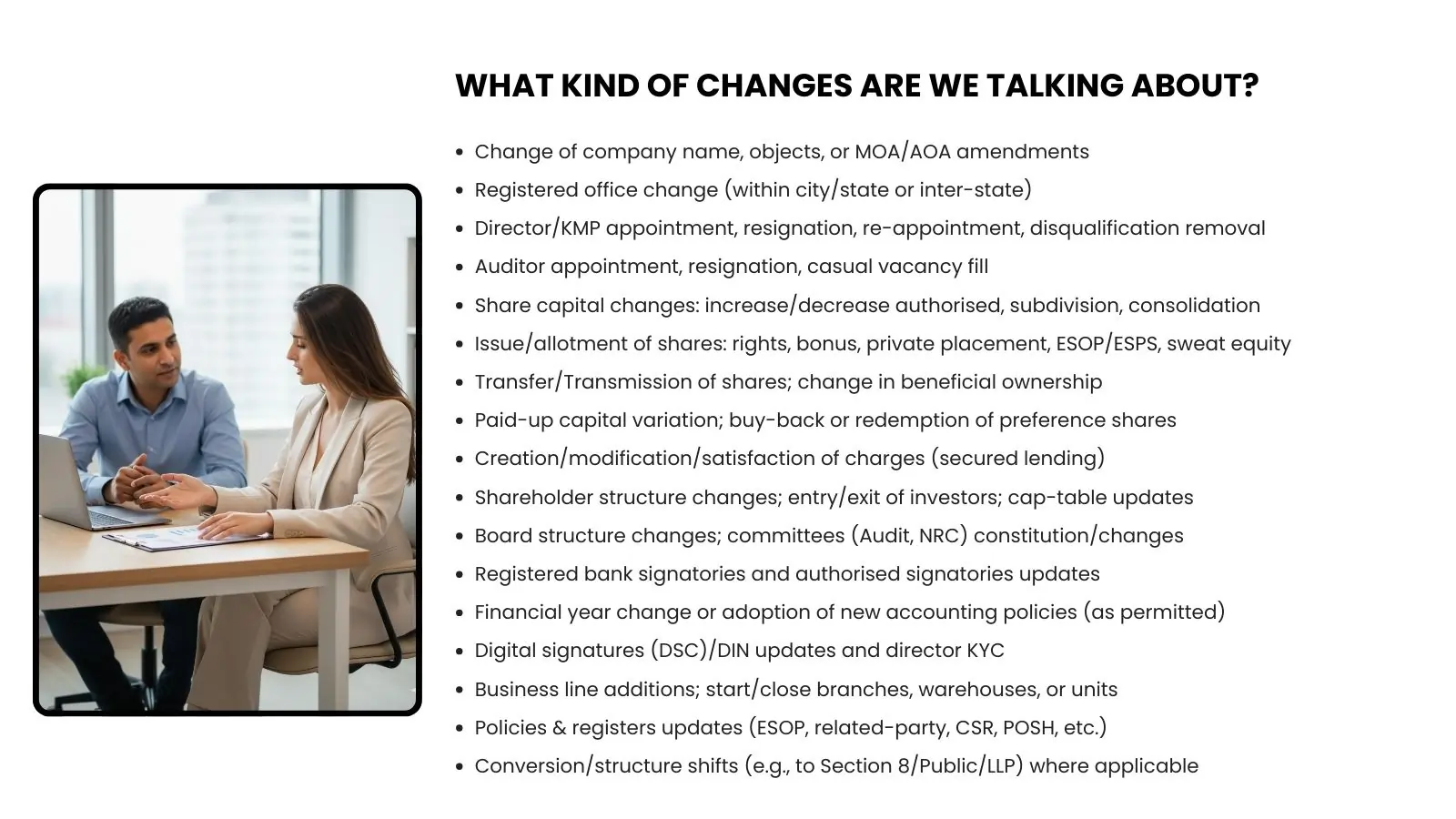
What can change in a Private Limited company?

Most growing companies re-work their charter, capital and boards multiple times – founders come and go, investors enter and exit, and new lines of business are added. The law permits this, but only if the changes are properly documented and filed.

Charter & Governance

MOA/AOA, Board & Policies

  • Amend name, objects, liability clauses and articles of association.
  • Board refresh – appointment/exit of directors, KMP and independent directors (where applicable).
  • Board committees: Audit, NRC, CSR, Risk, POSH ICC etc.
  • Policy & register updates – ESOP, related party, CSR, insider trading style codes, if applicable.

These changes shape your corporate constitution and are closely reviewed in due diligence and by regulators.

Capital & Investors

Share Capital, Issues, Transfers & Charges

  • Increase / decrease in authorised share capital and variation of classes.
  • Issues of equity / preference shares – rights, bonus, private placement, ESOP/ESPS, sweat equity.
  • Transfer / transmission of shares, beneficial ownership changes, cap-table realignment.
  • Creation / modification / satisfaction of charges for secured loans.

Capital moves must sync across ROC, cap-table, SHA/SSA documents, ESOP registers and banking lines.

Operations & Footprint

Offices, Branches & Business Lines

  • Registered office shift within city, State or across States.
  • Opening / closing of branches, warehouses, plants or business verticals.
  • Updates to bank signatories, authorised representatives and DSC / DIN-KYC.
  • Conversions or structure shifts – to Section 8, public company or LLP where permitted.

These changes need alignment across ROC, GST, local registrations, labour, and banking relationships.

Key documents for company changes
  • Latest MOA, AOA and certificate of incorporation.
  • Existing shareholders’ agreement, investment agreements and loan documents.
  • Board and shareholder meeting notices, agendas and minutes with explanatory statements.
  • Drafts of altered MOA/AOA, resolutions, offer letters, share transfer forms, ESOP grant letters and option exercise forms.
  • Updated cap-table and registers of members, transfers, charges, director & KMP details.
  • Proofs for registered office & branches – lease deeds, NOCs, utility bills.
  • KYC for directors/KMP, authorised signatories and beneficial owners; DIN-KYC and DSC details.
  • Bank mandates, charge documents, satisfaction letters and NOCs where loans are involved.
Professional Readiness™ for Company Changes

Professional Readiness™ score: 0 / 5 – Needs mapping

Internal readiness level

Let’s start with a mapping call – we’ll chart out what needs to change and in which order before you touch any forms.

From early-stage pivots to investor-heavy rounds and promoter exits, corporate changes leave marks that will be read for years. Our job is to make sure those marks look clean, deliberate and fully compliant.

Talk to a company-change expert

“We did a rights issue, ESOP rollout and investor entry within the same year. NoLegalPaisa aligned the SHA, MOA/AOA, PAS-3, SH-7 and cap-table so our diligence with a VC fund was completely smooth.”

Ankit Verma
Co-founder & CEO, SaaS Private Limited
Changes in PVT LTD Make Image

Changes in Private Limited Company — Detailed Flipbook

Frequently Asked Questions

It refers to modifications in a company's legal structure or operational details, such as adding or removing directors, changing the registered office, updating the business objectives, or altering the share capital structure.

Changes may be required to improve governance, align with growth strategies, attract investors, manage liabilities, comply with regulatory requirements, or reflect changes in business operations.

Common changes include:
  • Adding a director
  • Removing a director
  • Increasing authorized capital
  • Changing the company’s objectives or activities
  • Changing the registered office address
  • Closing (winding up) or striking off the company

Changes are initiated by the company's management through board or shareholder resolutions, with documentation signed off by the relevant parties.

The process starts with an initial assessment and decision-making session where we evaluate your business needs, strategic goals, and the potential impact of the proposed change.

Required documents typically include a board resolution, consent letter from the proposed director, and updated KYC documents (PAN, Aadhaar/Passport, address proof). Additional Form DIR-12 may need to be filed with ROC.

The removal process involves passing a board or shareholder resolution, collecting a resignation or termination letter, and filing updated details in Form DIR-12 with the Registrar of Companies.

You’ll need a board resolution, revised Memorandum & Articles of Association (if applicable), and filed forms such as SH-7. Updated financial statements and audit reports are also typically required.

We prepare and file the necessary amendments to the MOA/AOA, along with board/shareholder resolutions and the required ROC forms, to reflect the updated objectives.

The process includes passing a board resolution, preparing Form INC-22, and submitting supporting documents such as a rental agreement or utility bill to the ROC.

We help you prepare the required board resolutions, final accounts, and necessary notices for winding up, and file the appropriate forms with the ROC and other regulators as mandated by law.

Striking off involves filing an application with the ROC, supported by proofs of inactivity or non-operation, and updating all statutory records to confirm that the company is no longer in business.

Most changes are filed with the Registrar of Companies (ROC) under the Companies Act, 2013. Depending on the nature of the change, additional regulatory approvals may be required from other authorities.

Timelines vary by the type of change; simple modifications like updating the address might take 2–3 weeks, whereas complex conversions such as capital increases or winding up could take several months.

Yes, most changes require formal approvals via board or shareholder resolutions. This ensures that all changes are made in accordance with corporate governance standards.

Once approved, the changes are reflected in the company’s statutory records and publicly disclosed. You will receive updated certificates or documents confirming the change.

Our team reviews all applicable statutory requirements, drafts the necessary documents, and assists in filing accurate forms with the ROC to ensure complete compliance with the Companies Act, 2013, and other regulations.

Absolutely. We provide end-to-end support for single or multiple concurrent changes, ensuring that your company’s structure is updated seamlessly and efficiently.

Yes, we offer ongoing compliance and reporting services, ensuring that your company meets its annual filing, board meeting, and statutory obligations under the new structure.

Simply contact us through our online portal or call our dedicated support line to schedule a free initial consultation. We’ll assess your requirements and guide you through the entire process for updating your Private Limited Company.